Key question: How do I use AI to make my argument sharper instead of my prose blander?
The order that protects your voice
The researchers who get the most from AI all do the same thing: they write the ugly draft first. A rough paragraph in your own words plus AI critique beats a polished AI paragraph you then have to defend.
Dump your thinking as messy bullet points, your own words, no editing.
Ask AI for structure and gaps, not for sentences.
Write the section yourself using that structure.
Only then ask AI for line-level critique and clarity.
Prompts to copy and try
1. Turn messy notes into a section skeleton
Best in Claude or ChatGPT
Here are my raw notes for the [Introduction / Discussion] of a [FIELD] paper:
[PASTE MESSY BULLET POINTS]

Do NOT write the section. Instead:
1. Give me a paragraph-by-paragraph outline, with a one-sentence purpose for each paragraph.
2. For each paragraph, state which of my notes belong there and what evidence is still missing.
3. Show me the logical thread from paragraph 1 to the last one in a single flowchart-style list.
4. Point out any claim in my notes that is not supported by the evidence I mentioned.
'Do NOT write the section' is the key line. You get architecture, and the words stay yours.
2. Paragraph surgery on your own writing
Best in Claude
Here is a paragraph I wrote: [PASTE]

Analyse it as a journal editor:
1. What is the topic sentence actually claiming? Restate it in 10 words.
2. Does every following sentence support that claim? Flag the ones that drift.
3. Which sentences are padding, hedging twice, or saying the same thing?
4. Rate its clarity 1-10 and tell me the single change with the biggest impact.

Give me the analysis first. Only after that, show one rewritten version that keeps my vocabulary and sentence rhythm.
Analysis before rewrite. You learn the pattern, so the next paragraph you write yourself is better.
3. Build the Results-to-Discussion bridge
Best in ChatGPT or Claude
My key findings: [LIST 3-5 FINDINGS WITH NUMBERS]
My literature context: [2-3 SENTENCES ON WHAT PRIOR STUDIES FOUND]
My theoretical framework: [NAME]

For each finding, generate a discussion scaffold with four slots:
(a) restate the finding in one sentence,
(b) does it confirm, contradict or extend prior work, and which work,
(c) the most plausible explanation grounded in my framework,
(d) one rival explanation I must acknowledge.

Do not write flowing prose. Give me the slots so I can write them.
The four-slot structure is exactly what strong Discussion paragraphs do, and the rival explanation is what reviewers reward.
4. An abstract that earns the download
Best in Gemini or ChatGPT
Here is my full paper draft (or my Methods + Results + Conclusion): [PASTE]

Write 3 structured abstracts of 200-250 words: Background, Objective, Methods, Results (with actual numbers from my text), Conclusion.
- Version A: emphasise the theoretical contribution.
- Version B: emphasise the practical/policy implication.
- Version C: emphasise the methodological novelty.
Use only claims and numbers present in my text. Then tell me which version best matches [TARGET JOURNAL] and why.
Three framings of the same evidence show you what your paper is really contributing. This is a strategic decision, not a wording one.
5. De-AI your prose
Best in Claude or ChatGPT
Review this text for hallmarks of generic AI writing: [PASTE]

Flag and list every instance of:
- empty intensifiers (crucial, pivotal, delve, robust, comprehensive, landscape, realm, tapestry)
- three-item lists used for rhythm rather than meaning
- sentences that state the obvious or restate the previous sentence
- "It is important to note that" style filler
- vague attributions like "studies show" with no specific study

For each, quote it and propose a precise, discipline-specific replacement. Keep my hedging and my terminology.
Editors reject fluent-but-empty prose. This prompt removes the exact fingerprints that make a paper read as machine-written.
6. Titles, captions and keywords
Best in Gemini
Paper abstract: [PASTE]
Target journal: [NAME]

1. Propose 8 titles: 3 descriptive, 3 with a finding-forward claim, 2 with a colon structure. Max 15 words each.
2. Suggest 6 keywords that maximise indexing discoverability without duplicating title words.
3. For each of my tables/figures described here [PASTE DESCRIPTIONS], write a standalone caption that a reader could understand without the body text.
Captions and titles are where discoverability is won, and they are low-risk, high-return AI tasks.
Load your own past published papers as sources and ask it to describe your writing conventions.
Tip: Ask 'how do I usually structure a Discussion?', then keep that structure instead of a generic one.
Use Skills / Custom GPTs for a less-AI voice
All three major tools now let you save reusable instructions. ChatGPT Custom GPTs, Claude Projects, and Gemini Gems. Use them to lock in a writing style that sounds like you, not a generic assistant.
Upload 2-3 of your own published papers or strongest drafts as reference samples.
Give the skill a system prompt such as: "You are an academic writing coach. Rewrite text to match my register: direct sentences, minimal intensifiers, field-specific hedging, and no AI filler phrases. Preserve my terminology."
Apply the skill to one paragraph at a time, and compare its output with your original before accepting changes.
The goal is not to make the AI invisible. It is to make the prose recognisably yours.
Tips for Gemini Notebook
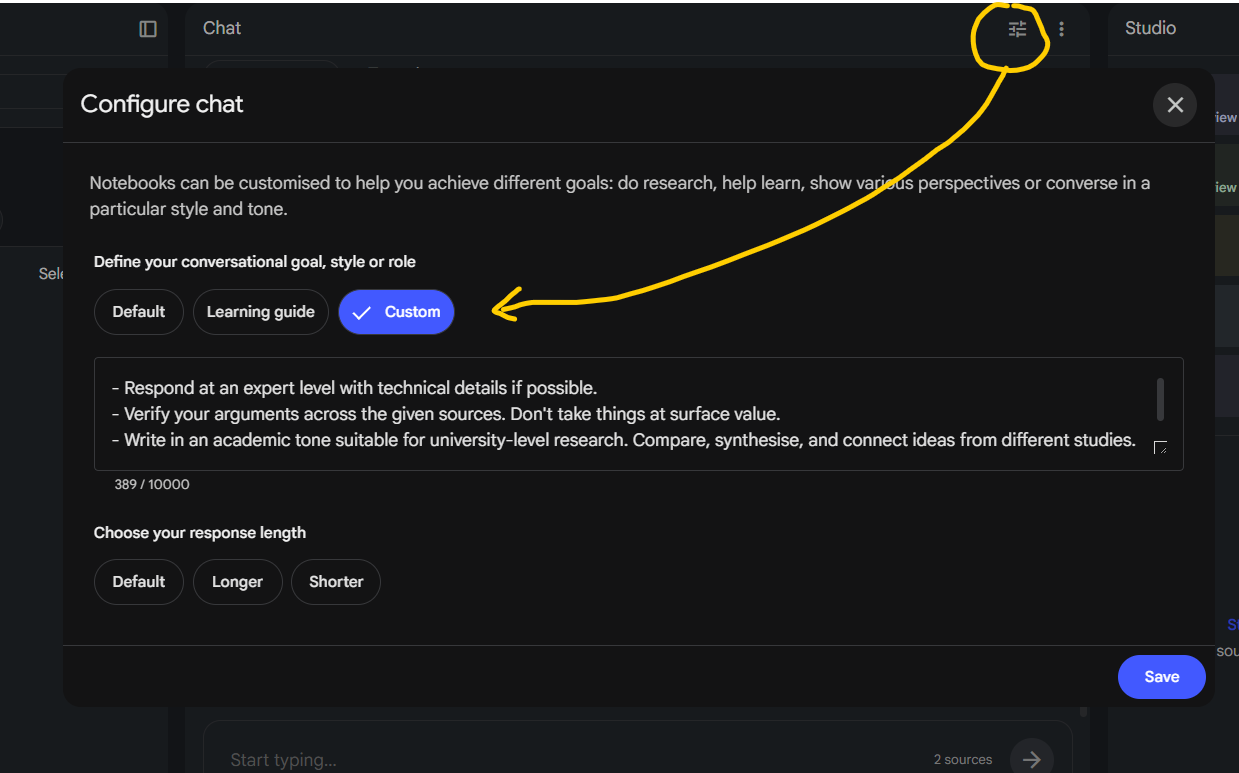
Set this as your Gemini Notebook chat configuration (Configure Chat button, top right of a notebook) so every response inherits these rules.
The Configure Chat panel lets you save a persistent system-style instruction for every notebook response.
Configure Chat for research optimization
Best in Gemini Notebook
Respond as an expert academic research-writing assistant. Use precise, technical language and prioritise conceptual clarity, methodological rigour and defensible argumentation. Verify claims across the supplied sources rather than accepting them at face value. Identify agreement, contradiction, gaps, limitations and unsupported assumptions.

Use APA 7th edition author-date citations beside each source-supported claim, not only at the end of paragraphs. Do not invent citations or overstate what the evidence supports. Distinguish clearly between established findings, interpretation, speculation and unresolved debate.

When revising text, improve academic tone, argument structure, synthesis, coherence, paragraph logic and citation integration while preserving the author's intended meaning. Prefer synthesis over source-by-source summary unless requested. If evidence is weak, missing or ambiguous, state this directly.
A persistent instruction beats repeated prompting. It keeps every summary, comparison and rewrite in the same academic register.
Integrity boundary for Part 3
Do this
• Write your own first draft, however rough, before any AI involvement.
• Keep the AI's role at structure, critique and clarity.
• Re-read every AI-touched sentence and ask: could I defend this in a viva?
Never do this
• Never submit a paragraph generated wholesale by AI as your own analysis.
• Never let AI insert a claim, statistic or citation you did not provide.
• Never let a rewrite quietly change the strength of your claim (from 'may suggest' to 'proves').