
AI in Research Writing
Balance scale beside a retracted journal article

Start here

Why integrity comes before productivity

Key question: What would you still be comfortable defending if a reviewer asked how this paragraph was written?

What is actually going wrong out there

Fabricated and mismatched citations

Chat models generate references that look perfect — real journal, plausible authors, invalid DOI. Papers have been retracted for exactly this, and reviewers now check.

Undeclared AI text in submissions

Phrases like 'as an AI language model', 'regenerate response' and 'certainly, here is' have appeared in published articles. Publishers treat this as a failure of author diligence.

Tortured phrases and hollow prose

AI-smoothed text often says less with more words. Editors describe it as fluent but empty — a desk-reject signal, not a quality signal.

Confidentiality breaches

Pasting an unpublished manuscript, student thesis, or a paper you are peer-reviewing into a public tool can violate journal policy and data protection rules.

Authorship and accountability

COPE and ICMJE are explicit: an AI tool cannot be an author. Whatever the tool wrote, you are answerable for it.

Activity: allowed, grey zone, or not allowed?

Decide for each scenario, then see how publishers generally read it. Your answer is recorded anonymously and shown on the presenter's live results screen.

Asking Claude to critique the logic of a Discussion section you wrote yourself.

Asking ChatGPT to 'give me 10 recent references on this topic' and pasting them in directly.

Uploading your unpublished manuscript to a free AI tool to polish the abstract.

Using AI to generate an extra 30 survey responses because your N is too small.

Listing ChatGPT as a co-author because it 'wrote a lot'.

Using Gemini Notebook (NotebookLM) to summarise 25 PDFs you have already downloaded and read.

Your baseline rules for the next two hours

Do this

  • Read every source you cite. AI may summarise it, never source it.
  • Keep a simple AI log: tool, what you asked it to do, what you changed.
  • Check your target journal's AI policy before you submit, not after.
  • Disclose AI use in the acknowledgements or a methods statement.
  • Use AI most heavily where the risk is lowest: structure, critique, clarity.

Never do this

  • Never let AI produce a reference list or a claim you have not verified.
  • Never generate, extend, or 'clean' data with a language model.
  • Never paste a manuscript you are peer-reviewing into an AI tool.
  • Never list AI as an author or hide that you used it.
  • Never submit a paragraph you could not defend in a viva or to a reviewer.

Copy this: a disclosure statement template

AI use disclosure (adapt to your journal's wording)

Best in Your manuscript

Declaration of generative AI use in the writing process

During the preparation of this manuscript, the author(s) used [TOOL NAME, e.g. ChatGPT (GPT-5), Claude, Gemini] for [SPECIFIC PURPOSE, e.g. language editing, improving readability of the Discussion, restructuring the argument in Section 3]. No content, data, references, or analytical results were generated by the tool. After using this tool, the author(s) reviewed and edited the content as needed and take(s) full responsibility for the content of the publication.

Concrete, bounded and honest. Naming the exact purpose is what distinguishes a compliant disclosure from a vague one.
Your notes are saved in this browser only.

What has changed in the last few months

Context engineering beats prompting

The best results now come from feeding AI rich context — your notes, sources, style guide and prior drafts — not from clever one-line prompts.

Models are becoming more agentic

ChatGPT, Claude and Gemini can now browse, code, plan multi-step tasks and even call other tools. The line between assistant and autonomous agent is blurring.

Reasoning models show their chain of thought

Newer models explain how they reached an answer, which helps you audit logic — but also makes it easier to over-trust a confident-sounding response.

Journals are tightening AI disclosure rules

Major publishers now ask for detailed statements on how AI was used. Vague disclosures are increasingly rejected during editorial checks.

Verification is still the human's job

AI can draft, summarise and critique faster than ever, but authorship accountability, fact-checking and ethical judgment remain firmly with you.

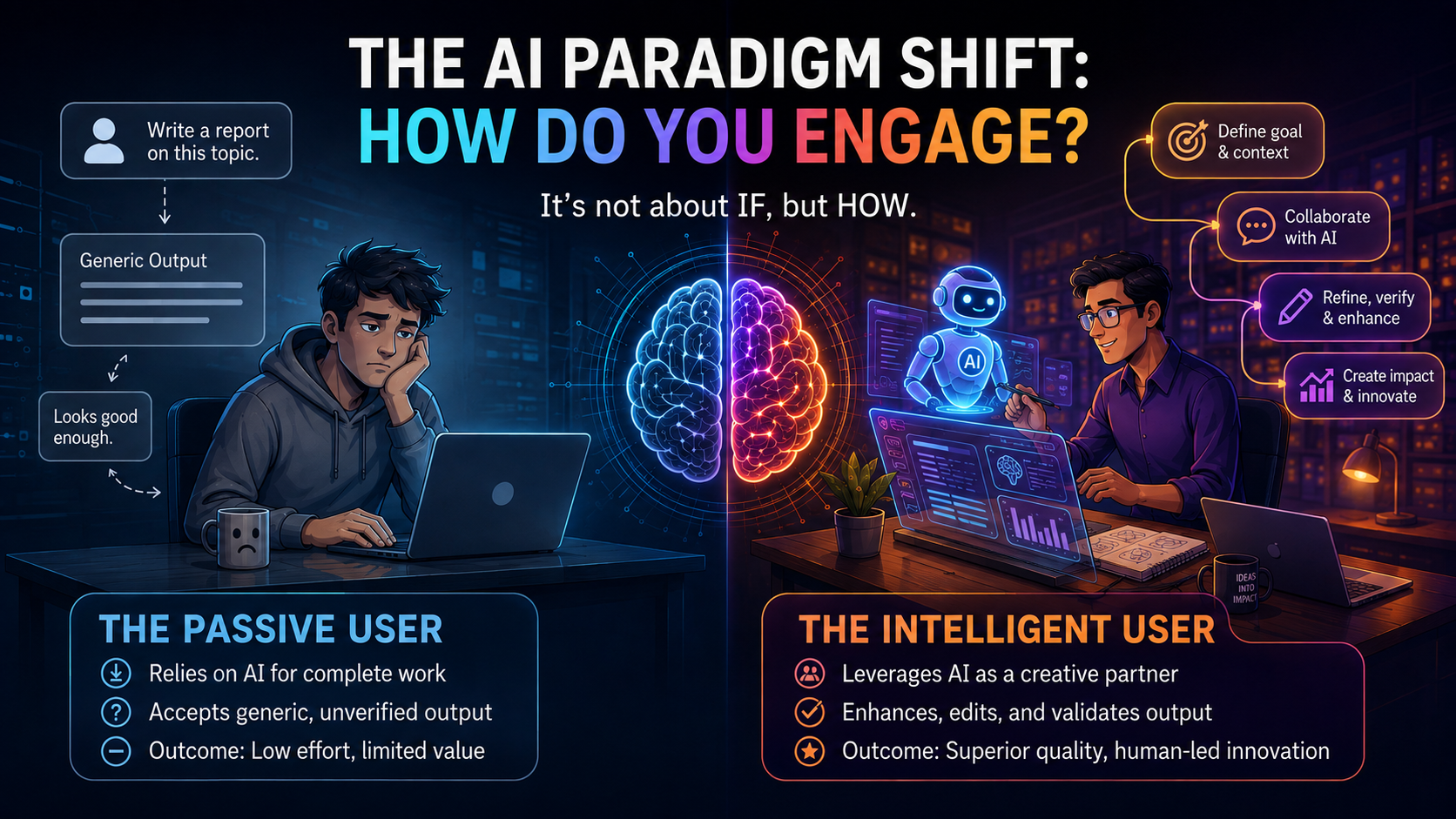
The AI paradigm shift: how do you engage?

Infographic comparing the passive AI user with the intelligent AI user

It is not about whether you use AI, but how. The left side shows the passive path — generic output, unchecked trust, limited value. The right side shows the intelligent path — define your goal, collaborate with AI, refine and verify, then create impact.